
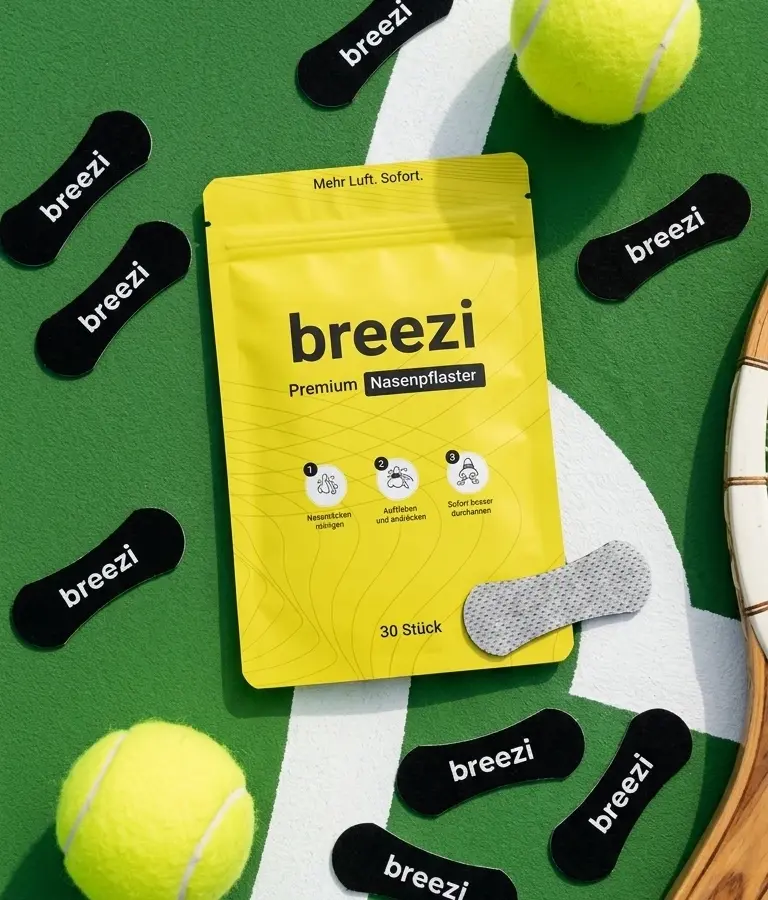
You can find this information on Breezi products CE certified medical device class I. For many customers this sounds technical - and rightly so. Behind the labeling there is a clear legal and qualitative framework that ensures that a product meets the European requirements for medical devices.
In this article we explain clearly what CE means, what Class I means and why this is relevant for a mechanical nasal plaster like Breezi.
What is the CE marking?
The CE marking is the visible sign that a product meets the essential requirements of the EU Medical Devices Regulation. In the EU this applies Regulation (EU) 2017/745, MDR for short.
Before placing it on the market, manufacturers must demonstrate that their product:
- is suitable for the intended medical purpose,
- works safely under normal conditions,
- has the necessary technical documentation,
- and complies with applicable quality and safety requirements.
For consumers, this means: The CE marking is not a marketing label, but rather regulatory evidence. Although it does not replace individual medical advice, it signals that a product has been tested and documented according to defined rules.
What does class I medical device mean?
In the EU, medical devices are classified according to the potential risk to patients and users. Class I is the lowest risk class. Typically these are products that:
- are not invasive,
- do not remain permanently in the body,
- and are usually only used for a short time or superficially.
The Breezi nasal plaster falls into exactly this category: It is worn on the skin on the outside of the nose area, has a purely mechanical effect and does not contain any active ingredients that are intended to be absorbed through the skin.
Mechanical effect instead of active ingredient
An important difference to many other products in the sleep or wellness area: Breezi works mechanically. The plaster pulls the nostrils slightly outwards and can help keep the nasal entrance open.
This means specifically:
- No chemical irritation from active ingredients
- No pharmacological effect in the classic sense
- A clearly understandable function that is immediately visible on the product itself
For people who find it difficult to breathe through their nose at night or who want more air during the day when exercising, this simple mechanism can be crucial.
Why trust in quality is important
Material quality, workmanship and skin compatibility are particularly important when it comes to products that you regularly wear on your skin. A CE-certified medical device must document manufacturer processes - from the product description to the risk assessment to the labeling on the Packaging.
For Breezi this means: Transparency is not a nice-to-have, but rather part of the product logic. If you use a nasal plaster daily or several times a week, you want to know that it not only fits comfortably, but is also seriously developed and correctly declared.
CE Marking vs. General Lifestyle Products
Not every nasal plaster on the market is automatically a medical product. Many items are sold as sports or lifestyle accessories - without the same regulatory requirements. The difference is particularly evident in:
- the intended purpose of the product,
- the technical documentation,
- labeling and traceability,
- and the responsibility of the manufacturer within the EU.
Anyone who consciously focuses on quality should therefore not only look at design and price, but also at the product classification.
Who is a CE-certified nasal plaster useful for?
A mechanical nasal plaster can be interesting for different situations - for example if you:
- you feel like you're not getting enough air through your nose at night,
- want to support more nasal breathing while training or running,
- you want to consciously breathe more calmly during the day during stressful phases,
- or are generally looking for an uncomplicated, non-invasive solution.
Of course, no nasal plaster replaces a medical diagnosis. If you have persistent breathing problems, snoring with daytime sleepiness or suspected sleep apnea, you should seek medical advice. For many people, however, a well-fitting nasal plaster is a useful component in a holistic recovery routine.
Quality that you can feel in everyday life
CE certification alone does not automatically make a product perfect for every person. What also remains crucial is how the plaster feels, how well it sticks and whether it supports your routine instead of disrupting it. That's why Breezi combines regulatory clarity with a focus on comfort and suitability for everyday use.
If you are looking for a product that not only looks good but is also clearly classified, it is worth taking a closer look at the labeling, material and intended purpose. This is exactly what the CE Class I marking stands for.
Suitable for: Use nasal plasters correctly · Allergy sufferers & stuffy nose